What If Adam and Eve Weren’t the First Humans?
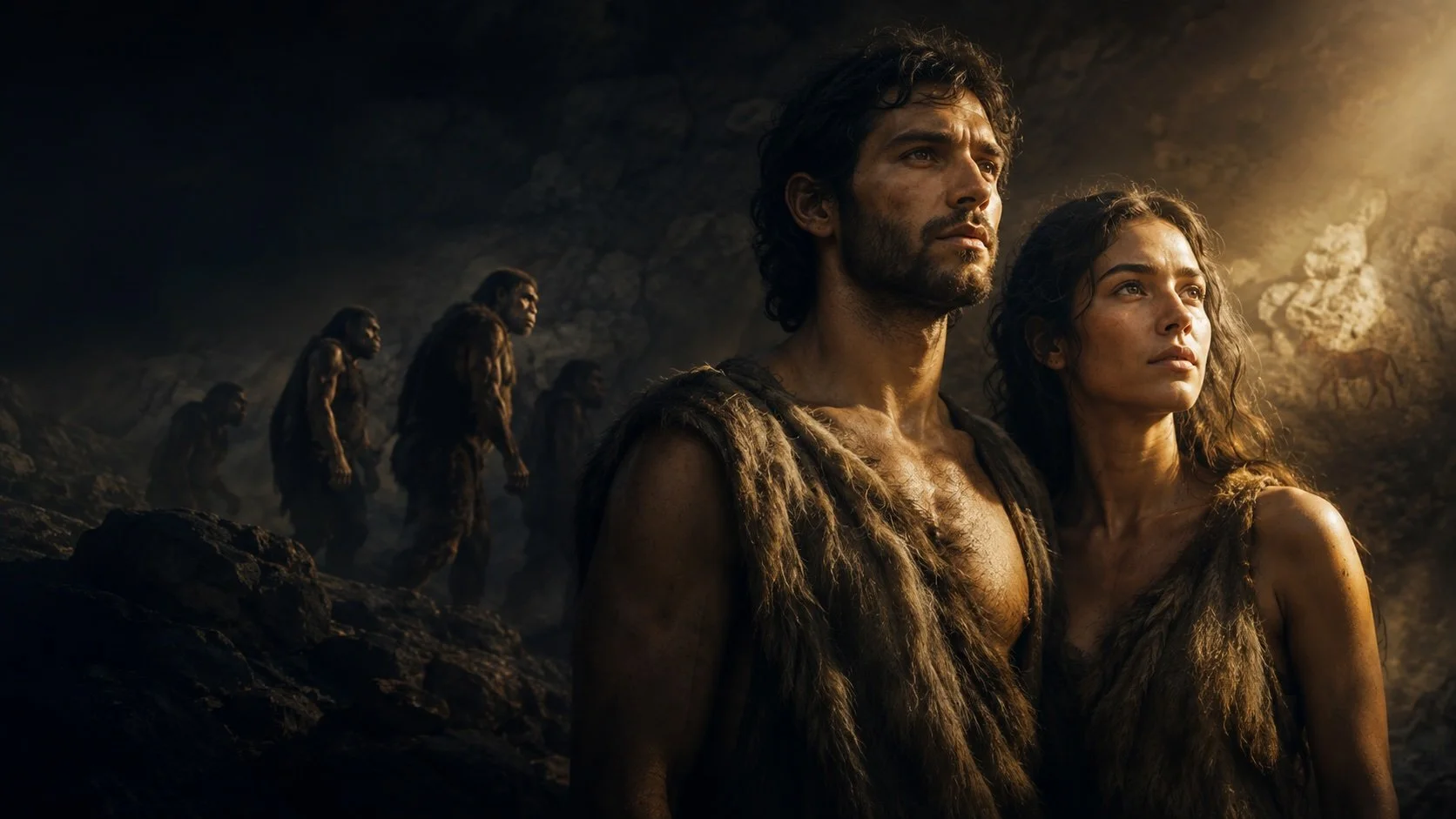
For many Christians, few subjects create more tension than human origins. Science tells us that Earth is billions of years old, that human beings have a long biological history, and that creatures resembling us existed long before the traditional date assigned to Adam and Eve.
Genesis, meanwhile, tells us that God created humanity in His image, formed Adam from the dust, created Eve, and made them the ancestors of the human family. So which story are we supposed to believe? Perhaps that is the wrong question.
Science seeks truth about nature. Scripture teaches spiritual and historical truth. If both are true, then an apparent conflict should encourage us to look more carefully at both the scientific evidence and our interpretation of the Bible.
That possibility opens the door to Biblical evolution: a model in which God deliberately guided the development of humanity over a long period and then, at a decisive point in history, created Adam and Eve as the first humans fully bearing His image.
It is not traditional young-earth creationism. It is not naturalistic evolution. And it is not theistic evolution in which God establishes the universe and then allows unguided evolution to do the rest.
It is an attempt to take both Genesis and the scientific record seriously.
Does Genesis Require Six 24-Hour Days?
A great deal depends on how we understand the word day. The Hebrew word yom often means an ordinary day, but it can also describe a longer period. Genesis itself uses the term flexibly. Genesis 2:4 refers to the entire creation period as “the day” in which God made the heavens and the earth. Biblical expressions such as “the Day of the Lord” likewise need not refer to twenty-four hours.
That does not mean the creation days must represent long ages, but neither does the Hebrew require Genesis to be read as a six-day scientific chronology. If the creation “days” describe periods of divine activity, an ancient Earth and a long history of life need not threaten the biblical account.
A Guided Human Story
Within the model developed in Beyond Chance, human creation was not one instantaneous biological event. God worked through a long, purposeful process.
An important stage appears with Homo erectus, followed by later Homo populations and eventually Homo sapiens. Across this history, we see increasing intelligence, flexibility, toolmaking, cooperation, and other capacities associated with humanity.
Then something remarkable becomes visible in the archaeological record. By the Upper Paleolithic period, humans increasingly display a striking combination of symbolic art, sophisticated tools, language, planning, abstract thought, and rich culture.
The pattern is more than simply a larger brain. It resembles what we would expect from beings capable of reason, creativity, morality, relationships, and spiritual awareness.
In this model, God was not standing at a distance watching evolution unfold. He was guiding the process toward a goal: a creature capable of bearing His image.
What Does the Image of God Mean?
Genesis says human beings were created in God's image. That does not mean that we physically resemble God. Rather, the image describes qualities that distinguish humanity in profound ways.
Human beings reason, exercise moral judgment, make purposeful choices, use sophisticated language, create, form deep relationships, understand abstract ideas, and seek meaning beyond survival. Most importantly, we possess the spiritual capacity to know and respond to God.
Animals communicate, cooperate, and sometimes use tools. But human beings build civilizations, develop mathematics, compose music, debate morality, create religions, write poetry, contemplate eternity, and ask why they exist.
The image of God also gives every human being inherent worth. Human value does not depend on intelligence, strength, wealth, health, race, sex, or social status. It rests in the Creator whose image we bear.
Adam: From Dust to Homo Dei
Genesis 2:7 says God formed Adam “from the dust of the ground” and breathed into him the breath of life. Traditionally, this has often been understood to mean that God instantaneously formed Adam's physical body from soil.
But “dust” can also emphasize humanity's physical connection to the earth. We are composed of the material of creation. We are mortal and dependent upon God.
Within the Biblical-evolution model, God could therefore have formed Adam using existing biological material. Adam would have shared the genetic architecture of Homo sapiens because he was physically connected to the biological history that preceded him. But then something new happened. God “breathed” into Adam.
In this model, that moment represents far more than respiration. It marks the divine impartation of the spiritual dimension of humanity—the capacity to know God, exercise moral freedom, reason at a distinctly human level, and enter a covenant relationship with the Creator.
Biblical evolution calls Adam the first Homo dei—“man of God.” He was biologically human, but humanity became something more than biology.
Genesis describes Eve as being formed from Adam's “rib,” although the Hebrew term can also mean “side.” Whatever the biological mechanism, the theological message is clear: Eve shares Adam's humanity and dignity. Together they became the first pair of Homo dei—human beings equipped not merely to survive, but to live consciously in relationship with God.
When Might Adam and Eve Have Lived?
Traditional biblical chronologies often place Adam only 6,000 to 10,000 years ago. That creates tension with archaeology and genetics because anatomically modern humans existed much earlier.
Biblical evolution proposes that Adam and Eve lived approximately 50,000 years ago, near the broad period in which humans increasingly display the constellation of behaviors associated with fully modern humanity: symbolic activity, sophisticated language, art, complex tools, planning, and expanding culture.
This does not mean archaeologists have discovered Adam's campsite. It is a proposed synthesis. The archaeological record gives us a window into the period when beings capable of fully expressing the image of God became visible in human behavior.
Were Adam and Eve the Only Humans Alive?
Genesis never explicitly says they were. Some passages may even be easier to understand if other humans existed. After Cain killed Abel, he feared that other people might kill him. He also found a wife and established a settlement.
Biblical evolution therefore proposes that other Homo sapien populations, without the image of God, existed when Adam and Eve were created. Adam and Eve were not necessarily the first anatomically modern humans. They were the first image-bearing humans.
Their descendants then intermarried with surrounding populations.
Through migration, intermarriage, and ordinary population processes, their lineage could spread until Adam and Eve eventually became genealogical ancestors of the entire human family.
Modern genetics shows that Homo sapiens interbred with Neanderthals and Denisovans and that small percentages of their DNA survive in people today. Within this model, such interbreeding is not surprising. As image-bearing Homo dei spread geographically, biology mixed and human populations became increasingly interconnected.
Eventually, all surviving humanity shared the image-bearing identity.
Biology Prepared the Vessel. God Supplied the Image.
That may be the simplest way to understand the proposal.
Evolutionary processes alone did not create the image of God. Genes did not manufacture spirituality. Mutation did not invent moral accountability.
Instead, God used a long biological history to prepare a creature capable of receiving something biology itself could never provide—His image.
Biology prepared the vessel. God supplied the image.
Seen this way, human origins become neither an accident of blind evolution nor a rejection of what science has discovered. They become a story of preparation.
Does This Solve Every Problem?
No. The model raises legitimate questions.
Biblical genealogies appear to place Adam much more recently, although Hebrew terms translated “father” and “son” can also refer to ancestors and descendants, allowing for omitted generations.
Cain is described as building a “city,” although the Hebrew term can refer to a smaller settlement. Cain worked the ground and Abel kept flocks, even though formal agriculture and domestication arose later. These descriptions may refer to earlier forms of plant and animal management or may use familiar language to describe ancient activities.
Such questions should not be dismissed. Bringing an ancient text into conversation with modern archaeology requires humility.
But unresolved details do not necessarily require us to choose between Genesis and science.
Genesis Does Not Have to Lose
The choice is often presented as simple: either accept modern science and abandon Genesis, or defend Genesis by rejecting the scientific record.
Those are not the only possibilities.
Biblical evolution offers a third.
God created life with purpose. He guided the human story. Adam and Eve were real people. Through them, humanity received something genuinely new—the image of God. Their descendants spread throughout the human family. The Fall was real, sin entered human history, and redemption became necessary.
Genesis remains history. Science remains valuable. And human beings remain what Scripture has always said we are: not accidental animals produced solely by blind forces, but creatures deliberately prepared and called into relationship with their Creator.
That is the central message.
God did not merely produce another animal. He prepared a creature capable of reason, language, love, moral responsibility, creativity, and worship—and then gave humanity something nature alone could never supply.
From dust came biology.
From God came our identity.
That is the journey from dust to design.
The concept of Biblical evolution presented here is developed more fully in Steve Osborne's Beyond Chance: From the Big Bang to the Empty Tomb.
